Home › Plumber Lancaster PA › Water Heater Replacement
Water Heater Replacement in Lancaster, PA
Water heater replacement in Lancaster, PA is the removal of an old, leaking or repeatedly failing water heater and the fitting of a new tank or tankless unit in its place, including reconnection, testing and haul away of the old heater where agreed. Tell us the fuel type, the size in gallons if you know it, and whether the old unit is leaking. We connect you with an independent local plumber who confirms the replacement scope and agrees the price with you directly before work starts.
At a glance
What is water heater replacement, and how is it different from repair and installation?
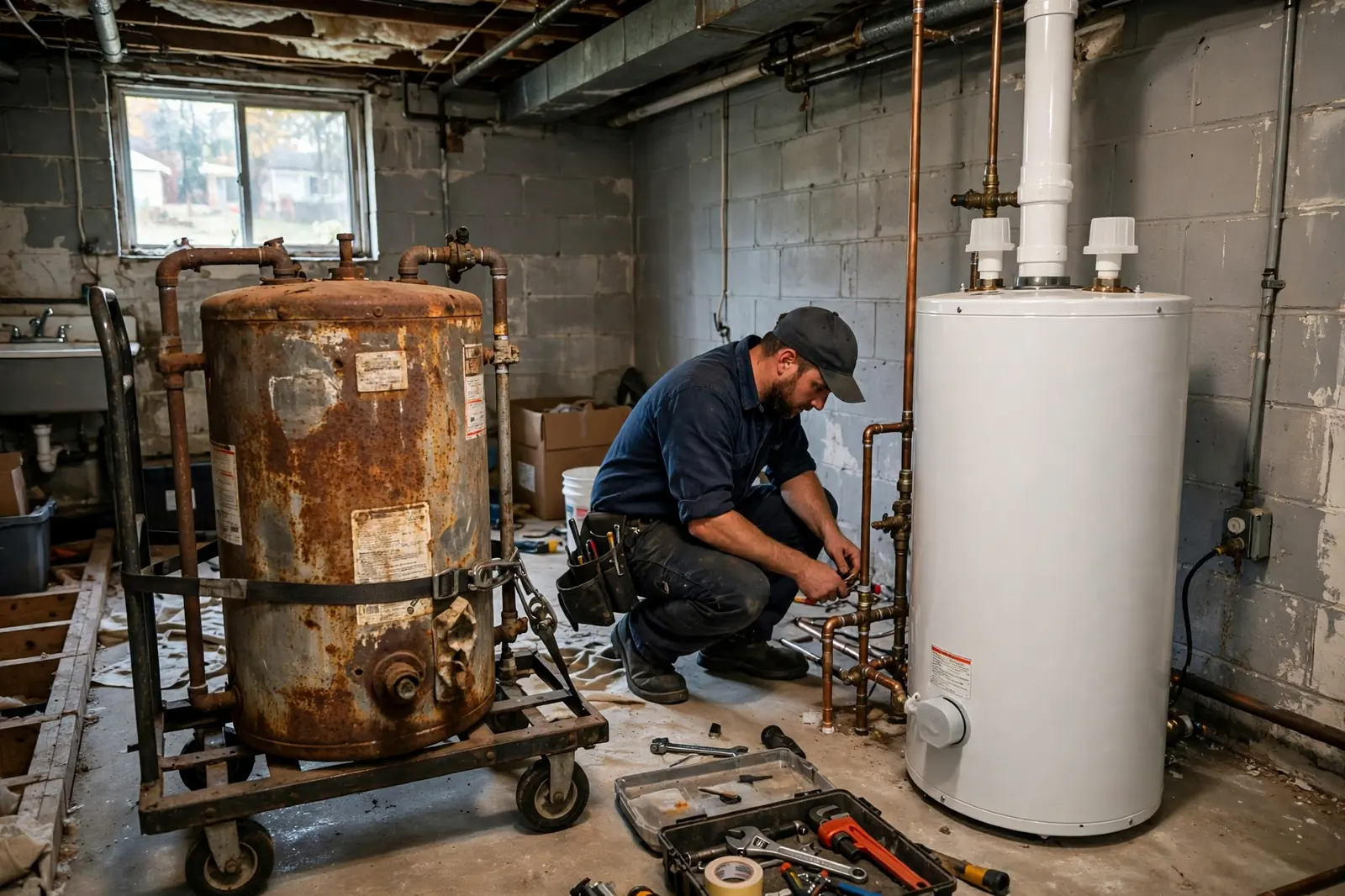
Water heater replacement is the removal of an old, failed or leaking water heater and the fitting of a new unit in its place, including draining and hauling away the old heater and reconnecting water, fuel and venting. It is the service you need when the old unit should not be repaired.
The difference matters. Repair fixes a part on a unit that is worth keeping. Installation fits a new unit, often for an upgrade, conversion or new location. Replacement combines both ideas: the new unit goes in, and the old unit, which is often leaking, heavy with sediment and awkward to move, comes out safely as part of the same job.
Plumbing Lancaster PA is a connection service, not a plumbing company. We connect you with an independent local plumber who confirms the old unit type and size, checks the space and connections, and agrees the full replacement scope and price with you directly. Start from our plumber in Lancaster, PA page if you also need other plumbing work handled on the same call.
What are the signs it is time to replace your water heater?
The strongest signs are water leaking from the tank body, rusty hot water with visible tank corrosion, repeated breakdowns, persistent rumbling from heavy sediment, and hot water that no longer meets household demand despite repairs. One sign alone may be repairable. Several together usually end the argument.
Do not wait for a tank leak to become a basement flood. In Lancaster homes with finished basements, a failing tank can release its full contents plus incoming water until the supply is shut off. If you see active leaking, shut off the supply to the heater if you can do so safely and call promptly.
How do you decide between repairing and replacing a water heater?
Decide by looking at the tank condition first, then the age and repair history of the unit, then the cost and disruption of the next likely failure, because a cheap repair on a corroded tank still leaves you with a corroded tank. Parts can be replaced. The tank cannot.
Repair is the stronger choice when the tank is dry and sound, the fault is one identifiable part, and the unit has otherwise run reliably. Replacement is the stronger choice when the tank leaks or is corroded, when repairs have become frequent, when efficiency and capacity have clearly dropped, or when a repair would cost a large share of a new unit while adding no life to the tank itself.
Also consider timing. Replacing on your schedule, with time to choose fuel type and size, is less disruptive than replacing under emergency pressure with water on the floor. If you are leaning toward repair, read the decision points on water heater repair in Lancaster, PA and ask the connected plumber to price both paths before you commit.
What type of replacement heater should you choose, electric, gas or tankless?
A like for like replacement is usually the simplest, while switching between electric and natural gas or moving from a tank to tankless changes the gas line, venting, electrical supply and drainage, so it should be planned as a conversion, not a swap. Each option suits a different house.
Electric tank replacement
Straightforward where electric service already feeds the old unit. Check element and tank size in gallons against current household demand, because replacing an undersized unit with the same size repeats the same problem.
Natural gas tank replacement
Needs the gas supply, venting and combustion air checked as part of the job. A new unit may not match the old vent exactly, so venting should never be assumed reusable without inspection.
Tankless replacement
Replacing a tank with a tankless unit frees floor space and heats on demand, but it needs peak flow sizing, service valves for descaling in Lancaster hard water, and often new venting and a condensate drain. It is a strong choice when planned, not when rushed.
What happens during a water heater replacement?
During replacement the plumber shuts off water and fuel, drains the old tank, disconnects and removes it, prepares the connections, sets and connects the new unit, then fills it, checks for leaks, starts it and tests hot water and safety controls. The old unit removal is a defined part of the job, so confirm it is in the scope.
Draining deserves care. A tank full of Lancaster sediment can drain slowly or clog its own drain valve, and a full tank is heavy, so it is emptied before it is moved. In a basement install, the route out matters too: stair width, door clearance and floor protection should be discussed before the day, especially in older Lancaster homes with narrow basement stairs.
Once the new unit is running, the plumber should show you the shutoff valve, the relief valve, the temperature setting and the drain point, and explain the flushing schedule for local hard water. If the job is an upgrade rather than a failure swap, the steps on water heater installation in Lancaster, PA describe the fitting side in more detail.
What affects the cost of water heater replacement?
Replacement cost is affected by the type and size of the new unit, its fuel type, any venting or supply changes, access for removing the old tank, and permit or code items, as well as the removal and disposal of the old heater. We do not list replacement prices here, because scope varies too much between homes.
New unit
size in gallons for tanks, capacity for tankless units, and electric compared with natural gas models.
Like for like or conversion
a conversion to tankless or a fuel change adds gas, venting, electrical and drainage work.
Venting
reusing a sound vent differs from running new venting.
Access
removing a tank from an open basement differs from a tight attic, closet or narrow stairway.
Related parts
expansion tank, shutoff valves, drain pan and supply lines may need replacing with the unit.
Permits
local permit or inspection steps can apply depending on the municipality and scope.
You agree the price directly with the independent plumber before replacement starts, including whether old unit haul away is included, so ask that question explicitly.
Why do Lancaster homes replace water heaters sooner than expected?
Lancaster County hard water is the main local reason, because mineral scale builds sediment in tanks, burns out elements, corrodes tanks from inside and shortens the useful life of both tank and tankless heaters. The anode rod, which is meant to corrode instead of the tank, is also consumed faster in hard water.
Basement conditions play a part too. Many Lancaster heaters sit in basements that are cool and sometimes damp, and a slow tank leak can go unnoticed behind stored items until it becomes a major leak. Checking around the base of the tank during normal basement visits, and reacting to rusty water or new rumbling early, gives you the chance to plan replacement rather than mop up after it.
When the new unit goes in, protect it. Ask for flushing access, a reachable drain, service valves on tankless models, and a maintenance routine that fits hard water. Treating the incoming water is the other half of the answer, so consider water softener options in Lancaster, PA if scale affects fixtures and appliances across the whole house.
How does Plumbing Lancaster PA work?
Plumbing Lancaster PA works in 3 steps: call, describe, connect. We are a connection service, not a plumbing company, so the plumber who arrives is a local independent tradesperson, not our employee.
Call one number
Dial (607) 305-8020 any time. The line covers Lancaster city and the whole county service area.
Tell us the problem
Say what is leaking, clogged or cold, and which town you are in. Urgent jobs get flagged urgent.
Get connected locally
We connect you with a local plumber who takes the job. You agree scope and price with the plumber directly.
Need this done in Lancaster, PA?
Call (607) 305-8020 and tell us the problem and your town. We connect you with an independent local plumber who takes the job, and you agree the scope and price with the plumber before any work starts.
Call (607) 305-8020Water heater replacement questions, answered
Can a leaking tank be repaired instead of replaced?
A leak from a valve, fitting or pipe can often be repaired. A leak through the tank body cannot, because the tank is a sealed vessel and corrosion that has worked through in one place is usually advanced elsewhere too. Replacement is the reliable answer for a tank body leak.
Will the plumber take my old water heater away?
Old unit removal and haul away should be confirmed as part of the replacement scope before work starts. Ask explicitly whether draining, disconnecting, carrying the old tank out and disposing of it are included, and whether any related parts such as the expansion tank are being replaced too.
Can I replace my water heater with a bigger one?
Often, yes, if the space, fuel supply, venting and drainage can support it. A bigger tank in gallons needs floor space and clearance. A larger tankless unit needs flow, fuel and vent capacity. The connected plumber will check the site before confirming the size.
Should I switch to tankless when I replace?
Tankless suits households that want hot water on demand and value the space saved, but the switch is a conversion that can need gas, venting, electrical and condensate work. In Lancaster hard water it also needs service valves and a descaling routine. Weigh that scope against a like for like tank swap.
What should I do while waiting for a replacement?
If the tank is leaking, shut off its water supply if you can do so safely, turn off power at the breaker for electric units, and move belongings away from the area. Avoid using hot water, and do not plug a discharging relief valve. Tell us about active leaking when you call.
How does Plumbing Lancaster PA work for replacement?
We are a connection service, not a plumbing company. Call (607) 305-8020, tell us the old unit type, fuel and symptoms, and we connect you with an independent local plumber. You agree the replacement scope and price directly with that plumber before work starts.
Old heater leaking in Lancaster? Plan the replacement now
Call (607) 305-8020, describe the old unit and any leaking, and we will connect you with an independent local plumber for replacement.